.svg)
Custom Scaffold
Guide cell alignment and securely position microtissues in a single, precision-manufactured scaffold.
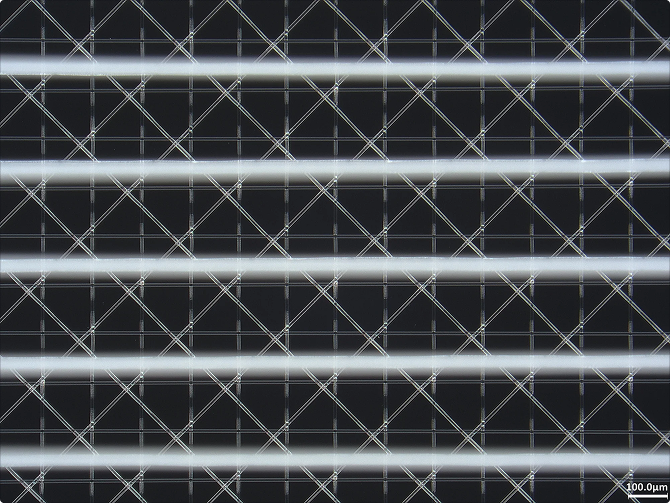
The Aligned Pattern with Catching Fibers scaffold combines directional fiber architecture with micro-scale capture features, enabling researchers to control both cell orientation and microtissue placement within physiologically relevant 3D cultures.
Guide cell alignment and securely position microtissues in a single, precision-manufactured scaffold.
The Aligned Pattern with Catching Fibers scaffold combines directional fiber architecture with micro-scale capture features, enabling researchers to control both cell orientation and microtissue placement within physiologically relevant 3D cultures.
KEY Benefits
1. Directional Guidance for Anisotropic Tissues
Aligned microfibers provide contact guidance cues that promote cell elongation, migration, and organization along a defined axis, critical for modeling tissues such as muscle, nerve, and tendon.
Why it matters: Random or isotropic matrices fail to replicate the structural cues present in native ECM, limiting biological relevance.
2. Integrated Catching Fibers for Microtissue Retention
Secondary “catching” fibers act as physical anchoring points for spheroids, organoids, or microtissues, reducing movement and positional variability during culture.
Why it matters: Improves reproducibility and spatial control in experiments combining scaffolds with pre-formed microtissues.
3. Micron-Level Architectural Precision via Melt Electrowriting
Manufactured using melt electrowriting (MEW), the scaffold delivers reproducible fiber diameter, spacing, and alignment, batch after batch.
Why it matters: Architectural consistency directly impacts experimental repeatability and comparability across studies.
4. Designed for Standard Lab Workflows
Scaffolds are compatible with standard multi-well plates. They are stable during seeding, media exchange, staining, and imaging. No specialized equipment is required.
Why it matters: Enables advanced 3D culture without disrupting established lab protocols.
Applications & technical highlights
This Pattern Is Well-suited For:
Aligned muscle, neural, and connective tissue models
- Organoid or spheroid-scaffold co-cultures
- Drug response and mechanobiology studies
- In-vitro models requiring controlled tissue architecture
Manufacturing Method:
Melt Electrowriting (MEW)
Architecture:
Aligned primary fibers with integrated catching fibers
Format:
Compatible with standard well plate configurations
Use Case:
3D cell culture and microtissue integration
Configurable Formats
This scaffold is available in multiple geometries and configurations to accommodate different experimental designs while maintaining consistent fiber alignment and architectural control.
In addition to flat formats compatible with standard well plates, the aligned fiber architecture can be fabricated in non-planar geometries, including tubular configurations. These formats are suited for models that require curvature, a defined lumen, or circumferential cell organization.
Experimental Relevance:
Scaffold geometry can influence cell organization, nutrient transport, and mechanical boundary conditions. Access to multiple form factors allows researchers to select a geometry that better matches their biological model without changing the underlying fiber architecture.
Use Cases May Include:
Flat scaffolds for aligned 3D cell culture and imaging in well-plate formats
- Tubular geometries for lumenized, circumferential, or axis-guided tissue models
- Alternative dimensions or layouts to match specific culture systems or devices
Configuration availability may vary. Contact us to discuss geometry options suitable for your experimental requirements.
Material science overview
Manufactured via melt electrowriting, this scaffold features precisely placed, continuous microfibers with controlled diameter, spacing, and alignment. The resulting anisotropic architecture provides predictable pore geometry and mechanical behavior, while integrated catching fibers introduce localized structural features without reducing porosity. Deterministic fabrication ensures consistent material properties and reproducibility across experiments.
technical documentation
How to Use This Product
For detailed guidance on handling, seeding, and culture workflows, visit the Getting Started page in our Support Center.
Documentation
Research Studies Using This Pattern
- [Article link]
- [Article link]
- [Article link]
- [Article link]
Custom Scaffold

Lattice
Lattice CF
Axis
Axis CF
IsoMesh
Box Pattern
GEOMETRY / DESIGN
Rectilinear grid with uniform pores (e.g. ~150 µm).
STRENGTHS
Highly reproducible, easy seeding and imaging; strong baseline models.
trade-offs
Limited directional guidance for anisotropic tissues.
USE CASES / TISSUES
Epithelial barrier models, organoids, baseline comparisons.
Box Pattern With Catching Fibers
GEOMETRY / DESIGN
Same grid design with stabilizing “catching” fibers spanning pore gaps.
STRENGTHS
Maintains spheroid / organoid stability in long-term culture; reduces movement during handling.
trade-offs
Extra fibers can slightly obstruct imaging and migration paths.
USE CASES / TISSUES
Long-term tumor spheroid culture, drug testing in 3D aggregates.
Aligned Pattern
GEOMETRY / DESIGN
Parallel fibers oriented in one direction; controlled fiber alignment.
STRENGTHS
Strong cues for cell alignment and elongation; mimics anisotropic ECM.
trade-offs
Less isotropic; biased growth may not suit mixed populations.
USE CASES / TISSUES
Muscle, tendon, neural, vascular alignment studies.
Aligned Pattern With Catching Fibers
GEOMETRY / DESIGN
Aligned scaffold with added cross-support fibers.
STRENGTHS
Combines directional guidance with scaffold stability; supports extended culture.
trade-offs
Higher fiber density may limit imaging clarity.
USE CASES / TISSUES
Long-term aligned tissue regeneration, mixed alignment + structure models.
Isotropic Pattern
GEOMETRY / DESIGN
Randomized, Multi-angle fibers producing decagon / omnidirectional pore geometries.
STRENGTHS
Mimics heterogeneous ECM; uniform diffusion; versatile for non-directional growth.
trade-offs
Lacks alignment cues; less suited for tissues requiring order.
USE CASES / TISSUES
Skin / epithelial models, barrier testing, wound healing.
VivoTex Custom 3D Scaffolds: Tailored to Suit Your Needs
VivoTex scaffolds can be tailored to replicate specific tissue environments, giving researchers control over architecture, porosity, fiber diameter, and mechanical properties. This flexibility enables precise experimental models for diverse applications—from regenerative studies to oncology and drug discovery.
Ready to try our scaffolds? Contact us and we'll send you a sample kit.